|
BY
Rashid Haidari
Friday, April 23, 2004
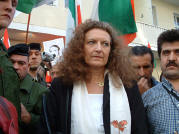
Berlin mayor, Monika
Thiemann’s courageous step to erect a plaque to
victims
of the Mykonos assassination should be considered as a great victory
for justice, freedom and human rights in Kurdistan and Iran in
particular and in the world in general.
The Mykonos Tragedy
happened in Sept. 17, 1992 when the General Secretary of Kurdish
Democratic Party of Iran, Dr. Sadegh Sharafkandi and his comrades
Fattah Abdoli, Homayoun Ardalan, as well as, Iranian politician Nouri
Dehkordi, a friend of the Kurds, were murdered by the hit men sent by
Iranian authorities.
Five years later, a
German court sentenced the assassins to life imprisonment and
confirmed that the murderers had been sent by top religious and
political leaders in Iran.
The sentence of the
German court caused serious tensions in relations between Iran and
European countries. Following the sentence, Germany called back its
ambassador to Tehran and the European Union suspended dialogue with
the Iranian regime which lasted about one year.
When Berlin mayor,
Monika Thiemann, revealed her plan to erect a commemorative plaque to
the victims of Mykonos, Tehran's mayor became irritated and told that
Berlin’s action was an insult to the Islamic republic of Iran. He
threatened that he would respond to it by erecting a plaque condemning
Germany for selling chemical weapons to Saddam's distorted regime.
Despite Tehran’s
threats, and after a three-week-delay, the brave mayor of Berlin
finally carried out unveiling the plaque in a vast ceremony in April
20, 2004 in which members of the victims’ families, hundreds of PDKI
members from different European countries, Kurds from different parts
of Kurdistan and Iranian and foreign friends of the Kurds
participated.
Despite vast, constant
human rights abuses and mass arrests of pro-democracy activists in
Iran and political executions in Kurdistan committed by The Islamic
Republic of Iran, European countries have, instead of a hard position,
conducted a soft policy, so-called critical dialogue, towards this
country. This policy has not only encouraged Tehran’s regime in
continuing its crimes against its own people, but, by supporting the
international terrorism and developing a nuclear programme, it has
become a real threat to the world peace.
It is time for
European countries to review their so-called critical dialogue towards
Iran and instead of dialogue with Tehran, they should support the
Iranian peoples in their struggle for a free, peaceful, democratic
Iran in which the human rights abuses will be ended for ever,
minorities' rights to self-determination will be obtained and the
threat to international peace will be removed. Let Monika Thiemann’s
heroic step be the beginning of a new era in Europeans’ policy towards
Iran.
|